

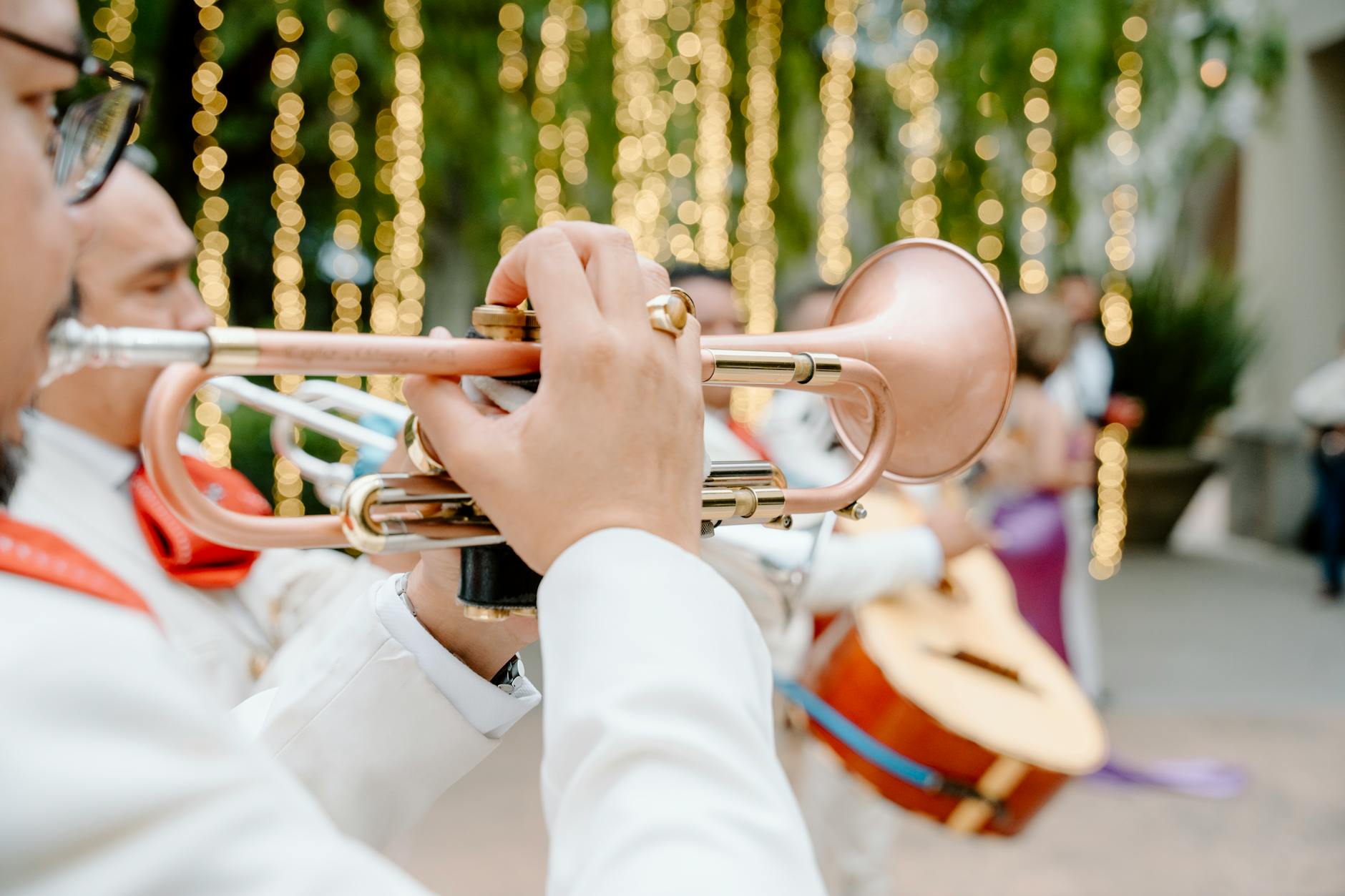
The music is what your guests will remember long after the flowers have wilted. Here’s how to get it right.
Ask anyone what they remember about the last wedding they attended. After the food, it’s almost always the music. A packed dance floor at 11pm, guests who didn’t want to leave, a first dance that made people cry — these are the moments that define an evening reception. And they’re almost entirely determined by one decision: who you book to provide the music.
The challenge is that music is deeply personal, and finding someone whose taste, energy, and professionalism matches what you want takes more than browsing a website and liking what you hear. This guide covers exactly what to ask — whether you’re leaning towards a live band or a DJ — and the red flags that should make you think twice before booking. If you’re still building your wider supplier team, our guide to finding wedding suppliers you can actually trust covers the contract and deposit basics that apply to every booking.
Before you contact anyone: agree with your partner on the overall feeling you want for the evening. High-energy dance floor from 7pm? Relaxed background music through dinner with a big finish? A mix of eras? Knowing your brief before you reach out means every conversation is sharper — and you’ll spot immediately whether someone is the right fit.
01. Band or DJ — Which Is Right for You?
This is the first decision and it shapes everything else. Neither is objectively better — they’re genuinely different experiences that suit different couples, venues, and budgets. Here’s an honest comparison:
| Factor | Live band | DJ |
|---|---|---|
| Atmosphere | Electric and unique — no two performances are the same. Live music has an energy that recorded music simply can’t replicate | Polished and consistent. A skilled DJ creates real energy and can match the exact feel of any track perfectly |
| Song flexibility | Limited to the band’s repertoire — typically 60–100 songs. Most will learn your first dance on request | Essentially unlimited — any track, any era, any genre. Perfect if your guest list spans multiple generations |
| Cost | £1,200–£4,000+ depending on band size, travel, and performance time. More musicians means more cost | £600–£1,500 for a professional. Generally lower cost, but quality varies widely at the cheaper end |
| Space needed | Requires a stage or significant floor space. A five-piece band needs considerably more room than a DJ setup | Minimal footprint. A DJ can set up in a corner and still fill a room — works well in smaller venues |
| Sound limiter friendly | Can be challenging — though acoustic and electronic drum options exist for venues with strict limiters | Generally easier to manage within decibel limits, though volume still needs careful monitoring |
| First dance | A live first dance is one of the most memorable moments a wedding can have — genuinely unlike anything else | The original recording — familiar, exactly as you know it, and deeply personal in its own way |
💡The hybrid option: many couples book a live band for the first two hours of the evening reception, then switch to a DJ for the late-night dancing. You get the spectacle of live music for the peak moment of the evening and the flexibility of a DJ for the rest. Some bands offer a DJ service as part of their package — ask specifically when you enquire.
⚠️Caution!
Check your venue’s sound limiter: many UK venues — particularly barns, listed buildings, and those in residential areas — have electronic sound limiters that cut the power if noise exceeds a set decibel level. This can stop a band mid-song. Always check with your venue whether a limiter is in place and what the decibel limit is, then pass this to any act you’re considering. Hitched has a useful guide to sound limiters and which types of acts work best with them.
02. Questions to Ask Both Bands and DJs
Regardless of which direction you go, these questions apply to every act you speak to.
- Are you available on our date — and will it be you specifically performing? — Some agencies book acts under a band name and send whoever is available on the day. Always confirm the specific musicians or DJ who will be at your wedding and ask to hear or see their work specifically, not the act in general.
- Have you performed at our venue before? — An act familiar with your venue already knows the acoustics, the layout, the loading access, and any quirks. If they haven’t been before, would they be willing to do a site visit or speak to the venue coordinator ahead of the day?
- What exactly is included in your fee — and what costs extra? — Travel, setup time, PA hire, lighting rig, MC duties, overtime rates. Get a written breakdown. Some acts include everything; others add equipment hire and travel as extras that can significantly change the final cost.
- How much space and setup time do you need? — Bands in particular need significant setup time — typically 2–3 hours before doors open. Make sure your venue’s access schedule allows for this, and that the performance area is large enough for the full act.
- Do you have public liability insurance — and can you provide a copy? — Every professional act should carry at minimum £5 million public liability insurance. Many venues require proof before allowing access. Any hesitation on this question is a flag.
- What is your backup plan if someone can’t make it on the day? — Illness happens. A professional act or reputable agency should have a named contingency plan — a replacement musician, a backup DJ, or at minimum a clear process for finding one quickly. “We’ll figure it out” is not a plan.
- What are your overtime rates? — Evening receptions run long. Know in advance what the cost per additional hour is and whether there’s a minimum overtime charge. Build this into your wedding budget from the start.
- Can you act as MC for the evening? — Many DJs and some bands offer MC duties — announcing the couple, introducing speeches, managing the flow of the evening. This is a genuinely valuable service that removes the need for a separate MC. Ask what their style is: some are energetic and theatrical, others are warm and low-key. Make sure it matches the tone you want.
03. Band-Specific Questions
If you’re leaning towards a live band, these additional questions will help you separate the genuinely great from the merely competent.
- Can we see a video of a live wedding performance — not a studio recording? — Studio recordings sound polished by design. A live wedding video shows you how the band sounds in a real room, how they interact with the crowd, and how they handle the energy of an actual event. Ask for recent footage, ideally from a venue with similar acoustics to yours.
- What is your full repertoire, and how much flexibility do you have? — Most wedding bands have a set list of 60–100 songs covering a range of eras. Ask for the full list. Can they learn your first dance if it’s not in their repertoire? Most professional bands will learn one or two songs on request — some charge extra for this.
- How many sets do you play, and what happens during breaks? — Standard wedding band format is two sets of 45–60 minutes with a break between. Ask what happens during the break — will they play background music through the PA, or will there be silence? Many bands offer a DJ or playlist service between sets as part of their package.
- How many musicians are in the band — and is that fixed? — Band size affects both cost and stage footprint. A four-piece band needs significantly less space and costs less than an eight-piece with brass. Ask whether the lineup can be adjusted if space or budget is a constraint — many acts offer different configurations.
- Are you sound-limiter friendly? — If your venue has a limiter, ask specifically whether the band can adapt. Some acts use acoustic drum kits, electronic drum triggers, or silent backline setups that allow them to perform within limiter restrictions without affecting the energy of the show.
04. DJ-Specific Questions
A great wedding DJ is much more than someone who plays music from a laptop. These questions help you identify the ones who genuinely know how to read a room.
- How do you approach building a set list for our wedding specifically? — A good DJ will ask you detailed questions about your guests, your tastes, and the energy you want. They’re not just playing tracks — they’re building a musical journey that takes people from dinner through to the last dance. Vague answers about “reading the room” without any process behind it are a warning sign.
- Can we provide a do-not-play list? — Every couple has songs they’d rather never hear again. A professional DJ will actively welcome a do-not-play list and treat it as seriously as your requests. Any resistance to this is a flag.
- What equipment do you use — and do you bring backups? — Professional DJs should be able to describe their setup clearly: mixer, decks or controllers, speakers, lighting rig. More importantly, they should carry backup equipment — a spare mixer, spare cables, spare audio source. Equipment failure at a wedding is rare but not impossible; a professional comes prepared.
- How do you handle requests on the night? — Some DJs welcome requests and weave them in seamlessly. Others prefer to manage the set themselves and treat requests as disruptions. Neither approach is wrong, but you need to know which camp your DJ is in so it matches your expectations and those of your guests.
- What is your style on the microphone? — Some DJs are natural, warm MCs who enhance the atmosphere. Others overdo it, talking over songs and making guests cringe. Ask how much they use the mic, whether you can hear an example, and be clear about how much (or little) commentary you want during the evening.
On booking through an agency vs direct: agencies like Alive Network and Function Central offer a layer of protection — vetted acts, insurance checks, and replacement guarantees if something goes wrong. Booking direct can sometimes be cheaper, but you lose that safety net. If you book direct, make sure you have a signed contract and check their insurance yourself.
05. Red Flags to Watch For
- They can’t show you video of a real live wedding performance. — Anyone can sound great on a studio recording or a carefully edited showreel. If they won’t or can’t show you recent live wedding footage, you have no idea what you’re actually booking.
- Vague or no answer on backup plans. — A band member pulling out the week before your wedding is unlikely but possible. A professional act has a contingency. If they shrug this off or give you a non-answer, move on.
- No public liability insurance. — Non-negotiable. Any act without it is not a professional act. Many venues won’t even allow them access without proof of insurance.
- They’ve never performed at a wedding. — Playing in a pub or a bar is a completely different skill set to managing the energy and emotional flow of a wedding reception. Ask specifically how many weddings they’ve played in the last 12 months. Fewer than five is a concern.
- They’re resistant to a do-not-play list or specific requests. — This is your wedding, not their gig. A professional act is there to serve your vision, not impose their own. Any DJ or band who makes you feel like your preferences are an inconvenience is telling you something important about how they’ll behave on the day.
- The price is dramatically below everyone else. — Experienced wedding acts charge what they charge because of what they bring. Dramatically below-market pricing usually means inexperience, poor equipment, or someone who moonlights at weddings without treating it as a professional service.
06. Your Pre-Booking Checklist
Before confirming any wedding band or DJ booking, make sure you can tick every one of these:
- Confirmed the specific act performing on your day — not just the act name
- Seen or heard live wedding performance footage — not just a studio recording
- Received a written, itemised quote including travel, equipment, and overtime rates
- Confirmed they have public liability insurance — and asked for a copy
- Understood the backup plan if someone can’t make it on the day
- Checked your venue’s sound limiter situation and confirmed the act can work within it
- Agreed on set times, break format, and what happens during intervals
- Discussed MC duties — who’s doing it and what style you want
- Provided a do-not-play list and confirmed they’ll honour it
- Read the full contract including cancellation and postponement terms
- Checked reviews on Hitched, Bridebook, and Google
The right band or DJ doesn’t just fill the dance floor — they set the emotional tone of your entire evening. The best ones make it look effortless: guests who didn’t plan to dance finding themselves on their feet, people who haven’t spoken in years suddenly singing together, a room full of people who genuinely don’t want the night to end. That’s what you’re looking for. Take the time to find it.
Leave a Reply